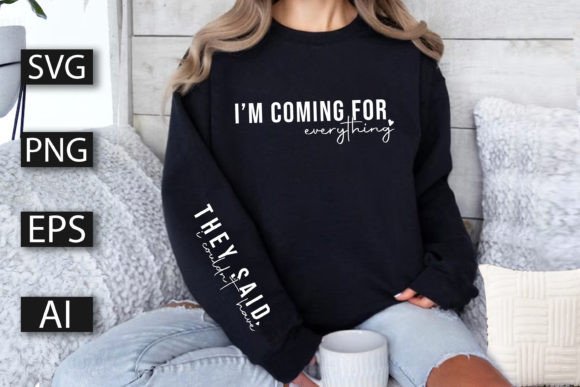
I’m Coming for Everything
First Impression: Bold, Unapologetic, and Ready to Stitch
When I opened I’m Coming for Everything for the first time, I didn’t just see lettering—I felt momentum. It’s not a whisper of motivation; it’s a declaration. The typography leans into confident calligraphy with subtle swashes and intentional weight shifts—thick downstrokes, airy upstrokes, and generous spacing that breathes even at modest sizes. As a machine embroidery design, its personality lands immediately: entrepreneurial, grounded, and quietly fierce. It doesn’t beg for attention—it assumes it. That makes it ideal for custom apparel meant to resonate with doers: makers launching their first Etsy shop, small-batch coffee roasters branding aprons, or wellness coaches embroidering tote bags for client welcome kits.
A Real Project Test: Embroidering It on a Heavy-Weight Cotton Tote
Last week, I stitched I’m Coming for Everything onto a natural canvas tote for a local ceramicist’s pop-up booth. We used a 4” × 4” hoop, medium-weight cutaway stabilizer, and matte polyester thread in deep charcoal. The result? Crisp, legible, and surprisingly tactile—the satin-stitched letters held clean edges without stiffness, and the open counters (like the “e” and “o”) stayed uncluttered. Customers paused mid-aisle. Not because it was flashy, but because it *felt* earned. That’s the quiet power of this design: it reads as handmade intention, not digital filler. It belongs on sweatshirts worn by founders, tea towels hung in creative studios, and baby onesies gifted to entrepreneur parents—not as irony, but as lineage.
Where It Shines—and Where It Needs Careful Handling
I’m Coming for Everything performs best on stable, medium-to-heavy fabrics: structured cotton tees, brushed fleece sweatshirts, linen-blend pillow covers, and twill caps. Its rhythm and scale translate well across embroidered patches, kitchen towels, and holiday gift wraps (think velvet pouches for small business launch kits). On baby embroidery? Use caution—opt for soft, low-density fill stitch and avoid tight curves near necklines where stitching could irritate sensitive skin.
It’s less forgiving on stretchy knits (like lightweight jersey t-shirts) without proper stabilization and hooping technique. Thin fabrics—especially light-colored silks or rayon blends—risk show-through or puckering if stitch density isn’t dialed back. And on dark fabric? Always test thread contrast: a warm taupe or slate gray reads richer than pure black, and avoids the “ink blot” effect some dense lettering creates.
Design Integrity Meets Commercial Reality
As an embroidery file, I’m Coming for Everything balances visual impact with practical execution. It’s not overloaded with decorative flourishes—no tiny spirals, no overlapping script loops that’ll vanish under thread. That means fewer re-hooping moments, cleaner trims, and faster turnaround for craft business owners juggling Etsy orders and craft fair prep. When stitched on a cap, the arch of the phrase follows the curve naturally; on a curved pillow cover, the baseline stays legible without warping.
But here’s what matters most to buyers: trust. A customer buying a personalized gift expects clarity, durability, and intentionality. This design delivers that—when executed well. It signals professionalism without cold perfectionism. That builds recognition: repeat customers start associating the phrase with your shop’s voice, especially when paired consistently across tote bags, patches, and digital mockups.
Practical Designer Notes Before You Stitch
- Test first—always run a sample on scrap fabric matching your final product’s weight and texture.
- Check thread color contrast on both light and dark backgrounds before committing to a palette.
- Review stitch density—if your machine struggles with dense fills, reduce density slightly rather than shrinking the design unnaturally.
- Confirm hoop size—this design scales well, but avoid pushing below 3” wide unless you’re using a specialized fine-needle setup.
- Inspect small details—especially the tail of the “g” and the crossbar of the “t”—they hold character but can blur if digitized too tightly.
- Try black-and-white mockups to assess legibility and hierarchy before adding color.
- Use appropriate stabilizer: cutaway for knits, tear-away for stable wovens, and fusible + tear-away for delicate linens.
- Verify licensing—since this is a digital embroidery file sold as Graphics and T-Shirt Designs, confirm whether commercial use (e.g., selling finished embroidered items on Etsy) is permitted before listing.
Final Thought: It’s Not Just Lettering—It’s a Statement With Staying Power
I’m Coming for Everything doesn’t chase trends. It anchors itself in typographic sincerity and emotional resonance—exactly what handmade product buyers respond to. Whether you’re embroidering a graduation gift for a friend launching her first side hustle, creating boutique-branded aprons for a co-op kitchen, or designing a limited-run patch series for a women-in-tech conference, this design carries weight without heaviness. It works because it respects the craft: it gives the stitcher room to execute cleanly, and the wearer room to embody its energy. In a sea of generic positivity quotes, I’m Coming for Everything stands out—not by shouting louder, but by meaning what it says.